


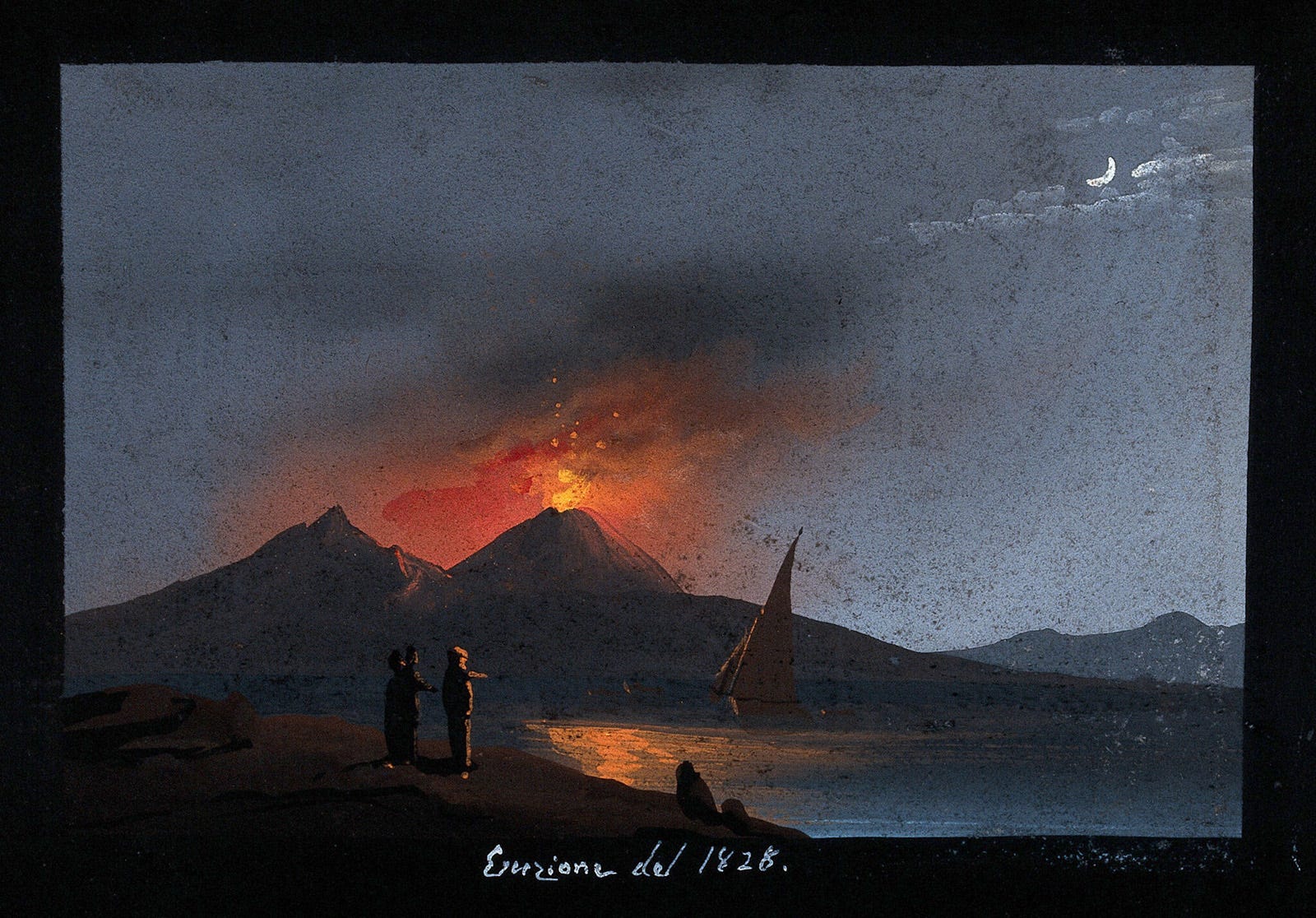
—Mount Vesuvius in eruption at night, 1828. (Wellcome Collection, London)
Last month, on the train from Salerno to Rome, I took photos of dark smoke clouds rising from the slopes of Mt. Vesuvius. There had been horrible fires in the Vesuvius National Park that were still not quite out. While nothing as dramatic as the paintings of Vesuvius erupting that were the height of fashion in the 19th century, it did make me think back to those Grand Tour travelers who yearned to see the volcano in its full fury. From the 18th to 19th centuries, Vesuvius erupted 14 times, with varying levels of force and destruction. Fortunately, the last eruption was in 1944, and travelers no longer arrive in Naples with the hopes of seeing an eruption. (Or, at least, they don’t say it aloud.)
Yet, climbing up to the top of the Gran Cono of Vesuvius—as I was reminded earlier this year while peering down into the volcano’s crater while standing shoulder to shoulder with dear friends—is always a reminder of how alive it still is. And those moments of feeling utterly alive? That’s a good reason to travel. Sharing it with my friends, and watching their sons in awe of the steam rising from the crater, made it even more meaningful.
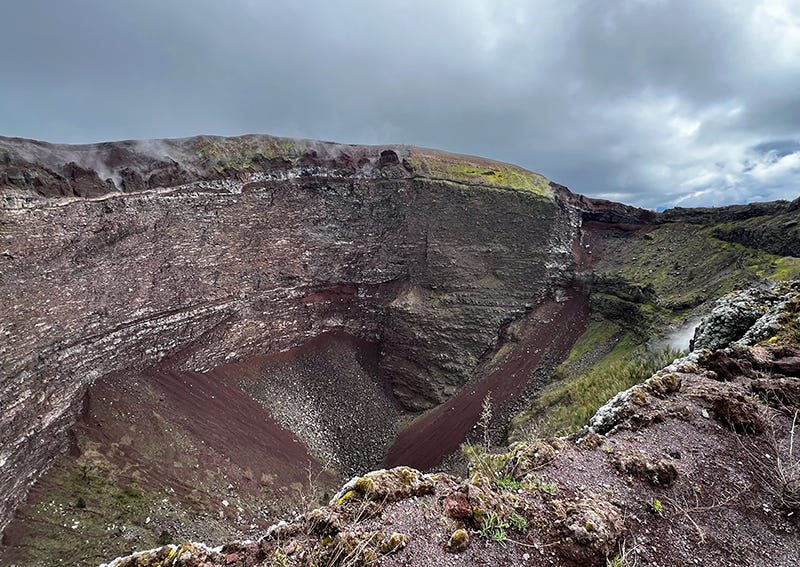
—A photo doesn’t even begin to capture the overwhelming experience of looking down into the Gran Cono of Vesuvius. The crater is about 1,500 feet across and about 984 feet deep).
While working on last month’s newsletter about traveling around Rome with the American poet H.W. Longfellow, I read some of his letters to his family that made me realize that Longfellow had also spent time in Naples in 1828. Over the recent years, my research and reading have been primarily focused on his later trip to Italy in 1869 when he visited Sorrento and Amalfi. But, as it turns out, his time in Naples seems to have been a quietly influential experience for Longfellow. And well worth a closer look!
But, first, we have to meet someone new. (Because traveling is always better with a good friend, right?) In April 1828, Longfellow set off from Rome to Naples with George Washington Greene (1811-1883), the grandson of Revolutionary War general Nathanael Greene, who he had met a few months earlier in his European journey while traveling across the south of France from Spain to Italy.1 The two became fast friends, and it was a connection that lasted a lifetime.
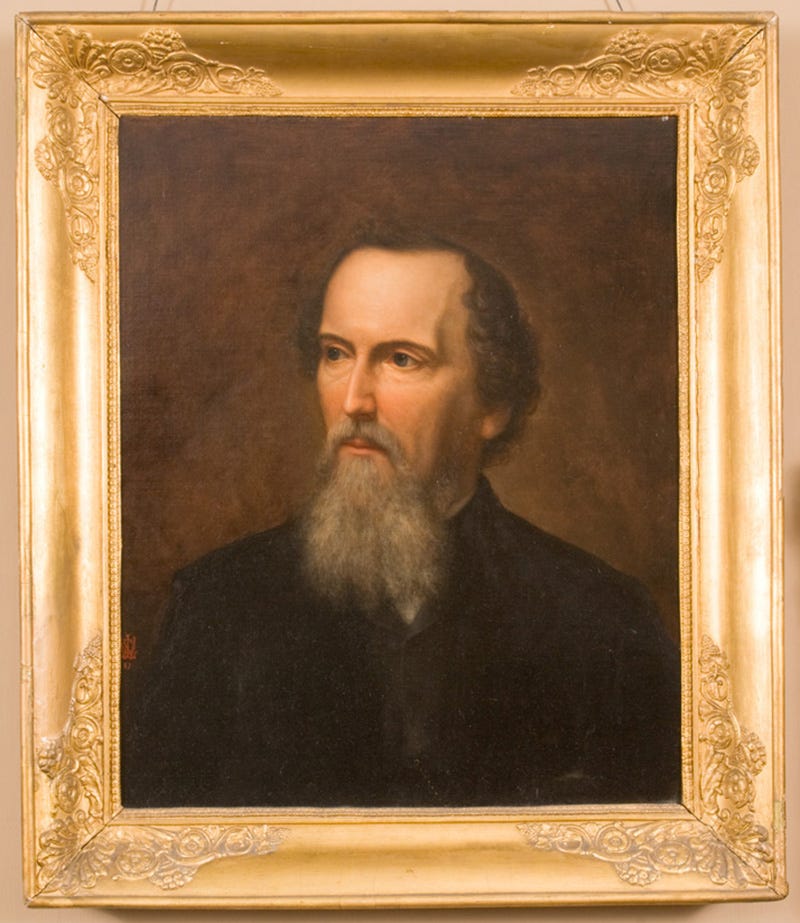
—Portrait of George Washington Greene painted by Longfellow’s son Ernest Wadsworth Longfellow, 1867. (credit)

Although I didn’t mention him in last month’s newsletter, Greene was a key part of why Longfellow had such a great stay in Rome. In his first letter from Rome, to his mother Zilpah Longfellow, he described the happy living situation that his new friend had helped him procure:
On arriving at Rome I found a friend of mine—Mr. Greene—of Greenwitch [sic], Rhode Island,—with whom I [had] travelled from Marseilles to Leghorn—and went into the same family where he was residing. And such a delightful family! I could write you a volume upon my good fortune in getting so pleasant a situation.2
This was just the beginning of what would become an extended stay in Rome for Longfellow. But what really caught my eye while reading this letter, dated March 26, 1828, was the part that came after his careful retelling of his new abode in Rome. After gushing about the Persiani family he was staying with and all he was learning, he mentions that it was Passion Week and the following week would be Holy Week. Then he shares some rather exciting news from Naples about an eruption of Vesuvius:
A few days ago we received the news from Naples, that there was an eruption of Vesuvius. Most all the English travellers at Rome set off post for Naples — and you hardly see the face of a foreigner in the streets at present — so powerful was the curiosity excited. For my own part I felt it and still feel it — but the uncertainty of reaching Naples before all should be finished — and the fear of not getting back for Holy Week at Rome — determined me to remain quiet: — always hoping that the final eruption will not take place for some weeks to come. Perhaps however that even now whilst I write, the splendid phenomenon is taking place. A month or two ago the shock of an earthquake was experienced at Naples — and a small island in the vicinity greatly injured — a village upon it being nearly destroyed and a great many people killed. From this and other prognostics of the eruption it was thought, that it would be violent. I regret exceedingly that I am not at Naples to witness it. Since the first report, we have received no further accounts, excepting confirmation of the fact.
As soon as "holy Week" is passed I shall go to Naples — and if all is over must content myself with looking at the lava — and the cinders and ashes. I hope that Pompeii and Herculaneum will not be buried again.3
Volcano tourism was a popular part of the Grand Tour, with Vesuvius looming large in the letters, diaries, and sketchbooks of travelers in Italy who hoped to catch one of the spectacular eruptions that were more frequent in the 18th and 19th centuries. Historian Noam Andrews has described: “The promise of viewing an active volcano kept grand tourists returning to Naples. As the highlight of any tour, a live action re-enactment of a historic catastrophe could be incorporated into their bedroom view and, safely mediated by distance, relegated to a source of entertainment.”4 A young Longfellow—only 21 at the time—could hardly be blamed for not wanting to miss out on such an experience. Vesuvius was, after all, 19th-century FOMO at its most spectacular.
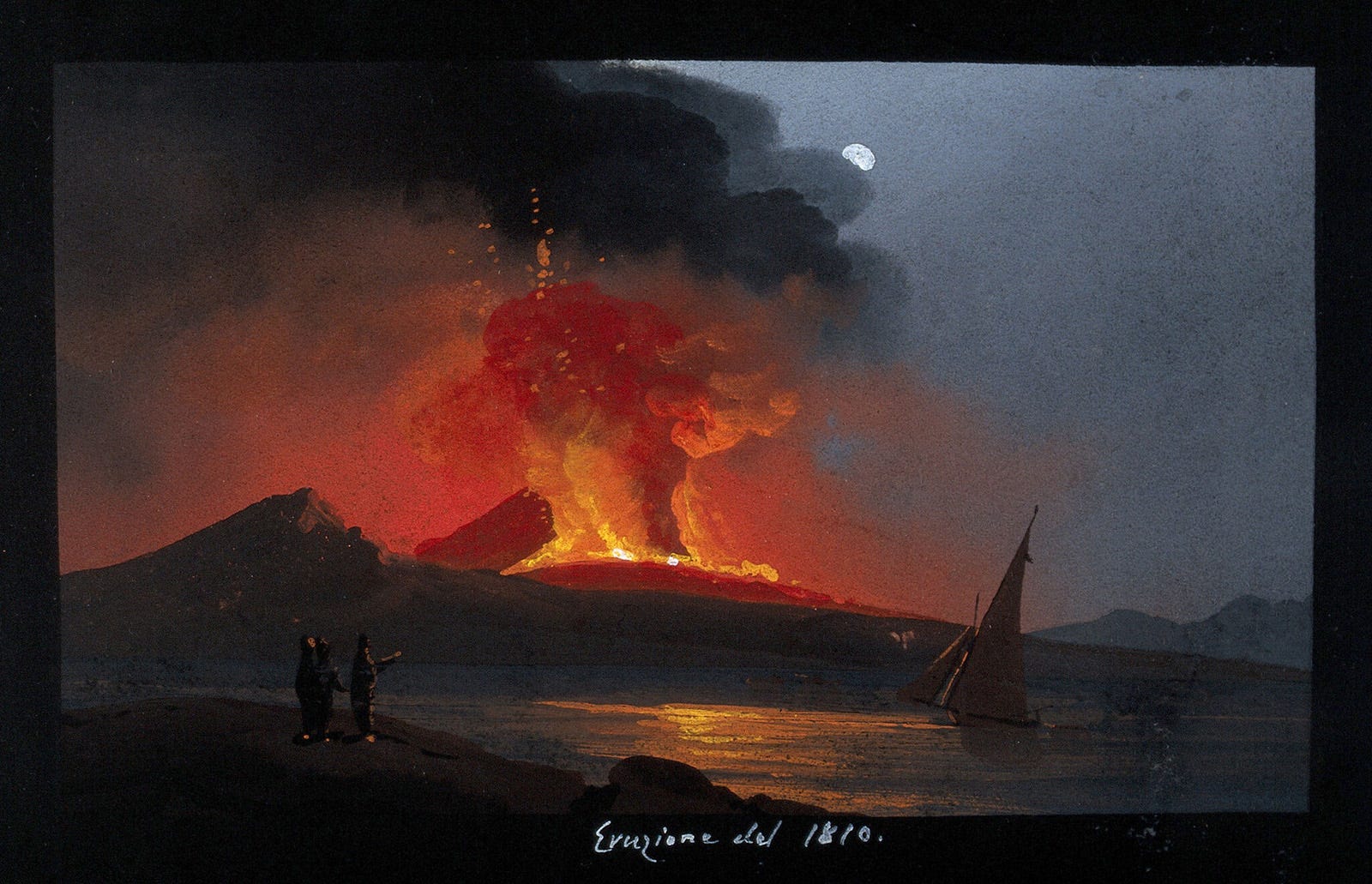
—Mount Vesuvius in eruption at night, 1810. (Wellcome Collection, London)
Fortunately, Longfellow was smart to stay for Easter in Rome—a spectacular affair in itself—especially since he added in a later note to the same letter that he had heard the eruption “was very slight.” No doubt Longfellow was hoping to see something much more like the depictions of the violent 1810 eruption of Vesuvius above.
Side note: Did you clock that mention of an earthquake in Longfellow’s letter? I sure did. Digging around, I believe he was describing the terrible events that took place on Ischia on February 2, 1828.5 A strong earthquake caused significant damage in the town of Casamicciola Terme, especially the upper part, where all the buildings were seriously damaged and many collapsed. There were 29 deaths and 50 injuries and damage widespread enough on the island to certainly fit his description of “a village upon it being nearly destroyed and a great many people killed.” One could dive deep into the seismological history Ischia, but now back to our regularly programed volcano-inspired story.
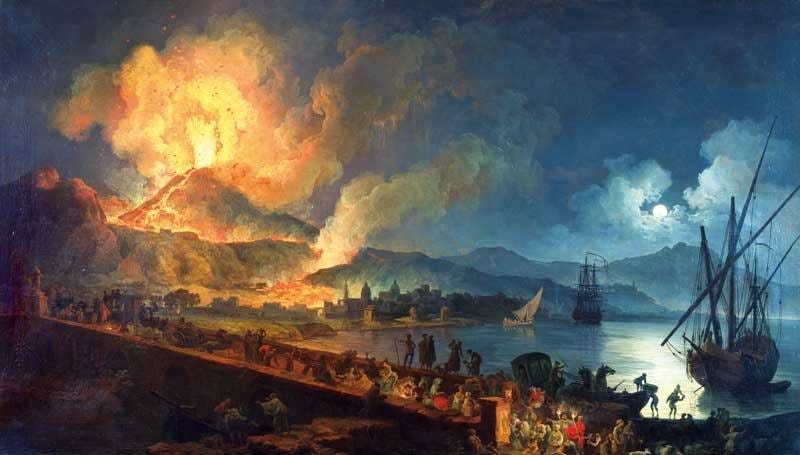
—Eruzione del Vesuvio del 1771 o 1779, Pierre-Jacques Volaire (1782). (credit)

But wait, did Longfellow ever make it to Naples then? His trip was easy for me to miss because he chose to leave his Neapolitan interlude out of his book Outre-Mer: A Pilgrimage Beyond the Sea. I found this curious, especially after reading how eager he was to see Naples and Vesuvius. It wasn’t until I started poking around in letters that I read another remarkable one written to his brother Stephen Longfellow, Jr. from Naples on April 22, 1828. Not only did he make it Naples, he stayed for about three weeks! Anyone who has experienced Campania in the springtime will know just how lovely it can be. For Longfellow, it was even lovelier than poetry and painting!
Indeed — you see nature here as it glows in painting and blooms in song: — not that nature is not always more lovely in herself — than in the Poet's album and the Painter's sketch book: —but you find in the scenery of Naples those rich combinations — which, were they found every where, would make the world we live in, too much of a Paradise.6
And that classic Grand Tour experience of enjoying a view of Vesuvius from your bedroom? Well, he checked that off his list too:
My windows overlook the bay of Naples — and directly in front of me on the other side of the water rises the broken cone of Vesuvius — with a thin light cloud of smoke wreathing itself about its summit — and fading away into the blue of the atmosphere.7
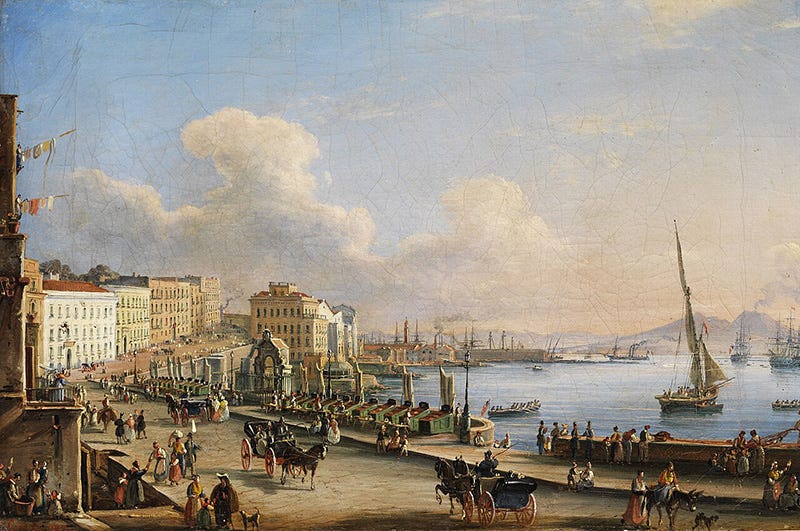
—Italian: Napoli da Santa Lucia, 1840. Salvatore Candido. (credit)

On this Neapolitan jaunt, Longfellow was accompanied by his new friend Greene. They stayed in or around Santa Lucia which certainly would have offered one of the best views of the Gulf of Naples. Complete with a view of Vesuvius, of course.
In his letter to his brother from Naples, Longfellow just begins to describe the views and some of the local curiosities before the letter suddenly picks up again later in Rome. I’d like to think he was swept away from his letter writing by something interesting happening beyond his window or Greene pulling him out into the street to explore. All we know is that when Longfellow resumed writing from Rome, he says that Naples was “one of the most interesting spots I have visited.”8
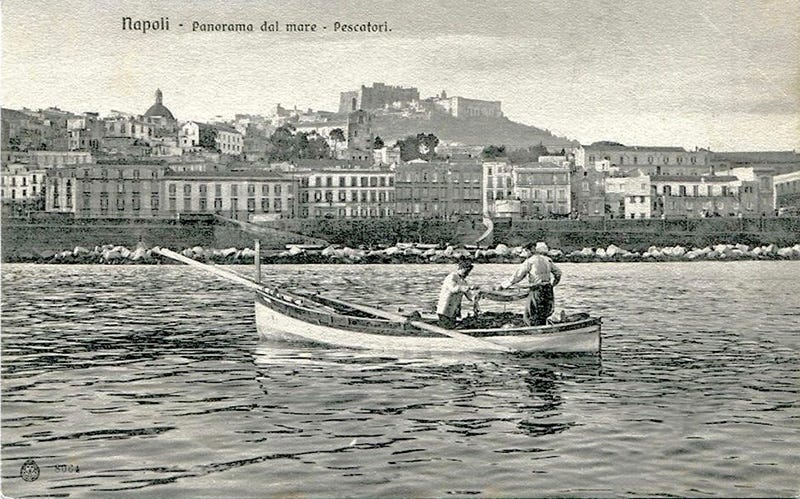
—Just me imaging what kind of capers two twenty something boys would have gotten up to in Naples in 1828. (credit)

Since Longfellow wasn’t much of a travel diarist, this letter to his brother offers a rare glimpse into what he saw while in Naples. Although only one long paragraph, he writes about going to Baiae, an ancient Roman town north of Naples, as well as the Phlegraean Fields and Lago d'Averno, where he imagined the entrance to hell while being boated across the lake (“for only two cents!”). All popular destinations for Grand Tour travelers, especially ones with an interest in and knowledge of ancient history like Longfellow. Naturally, he had to visit the Tomb of Virgil in Posillipo, which “at sunset it is lovely beyond description.”9
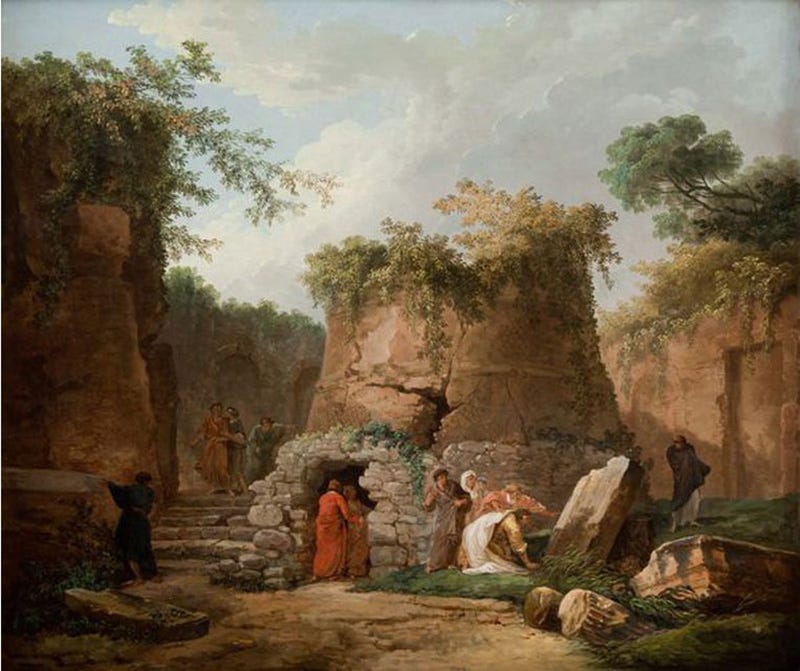
—The Tomb of Virgil at Posillipo, near Naples by Hubert Robert, 1784. (credit)

That, unfortunately, is it – “beyond description.” And, while I was going to leave it at that, I still wondered what Longfellow really thought of Naples. Did he ever actually make it to Pompeii? Did he climb Vesuvius? Why didn’t he write more about it? Plus, I was still left with the question of why he chose to leave Naples out of his travel book Outre-Mer. Perhaps three weeks wasn’t nearly enough for him to begin to see the city and everything there was in the area. Compared to the time he spent in Rome—nearly a year—a few weeks is nothing for a traveler like Longfellow who seemed to absorb places like he did languages – instinctively and deeply but certainly not quickly.
Yet, there is another possibility, hidden away in a letter Longfellow wrote to his sisters in September 1828, after a tough summer illness had forced him to retreat to Ariccia outside Rome to recover. This is from a Longfellow already deeply taken by Rome, but struggling to capture its beauty in words:
I dare say you have wondered not a little that in none of my letters I have spoken of Rome in the rapturous language of a modern tourist. But with me all deep impressions are silent ones. I like to live on, and enjoy them, without telling those around me that I do enjoy them. Besides, when I attempt a description, I find the effect it produces in reading so infinitely inferior to the effect I think it should produce, — and all I have seen described in painting and poetry is so very inadequate to convey an idea of what Rome is, — that when I sit down to my task, I find it a very cold and ungrateful one.10
Could it be that Naples left such a deep impression on Longfellow that he chose to stay silent about his memories, to keep them—and “enjoy them”—all for himself? He did, after all, write to his brother that Naples was “beyond description.” Even years after his time in Naples, Outre-Mer was published between between 1833 and 1834, he still wasn’t up to the task of capturing the city in words in a way that represented what he saw and seemed to have been very moved by while he was there.
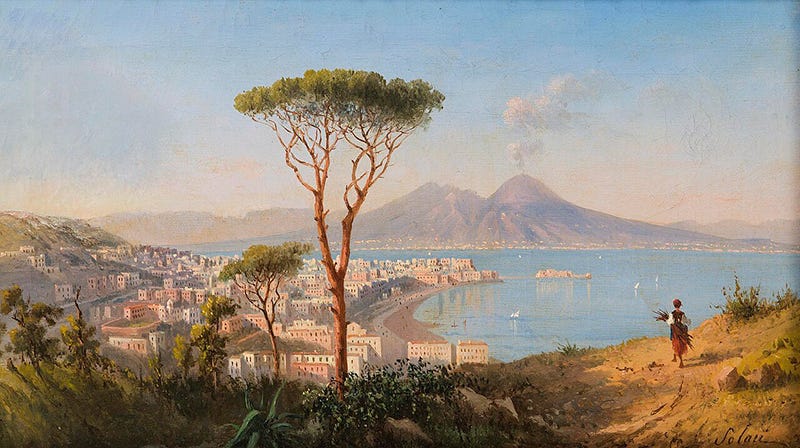
—A View of Naples and Vesuvius, Unknown, second half of 19th century. (credit)

There’s one more clue though, given to us by his Naples travel companion. Yes, the one and only George Washington Greene. Many many years later, when Greene published his 3-volume biography of his grandfather The Life of Nathanael Greene (1867-1871), he included a lengthy dedication to Longfellow. (Much deserved because he had subsidized the publication of the work. What a good friend!)11
My dear Longfellow, —
Thirty-nine years ago this month of April, you and I were together at Naples, wandering up and down amid the wonders of that historical city, and, consciously in some things and unconsciously in others, forming those precious associations which are youth's best preparation for age. We were young then, with life all before us; and in the midst of the records of a great past, our thoughts would still turn to our own future. … From then till now the spell of those days has been upon us.
One day — I shall never forget it — we returned at sunset from a long afternoon amid the statues and relics of the Museo Borbonico. Evening was coming on with a sweet promise of the stars; and our minds and hearts were so full that we could not think of shutting ourselves up in our rooms, or of mingling with the crowd on the Toledo. We wanted to be alone, and yet to feel that there was life all around us. We went up to the flat roof of the house, from whence, as we walked, we could look down into the crowded street, and out upon the wonderful bay, and across the bay to Ischia and Capri and Sorrento, and over the housetops and villas and vineyards to Vesuvius. The ominous pillar of smoke hung suspended above the fatal mountain, reminding us of Pliny, its first and noblest victim. A golden vapor crowned the bold promontory of Sorrento, and we thought of Tasso. Capri was calmly sleeping, like a sea-bird upon the waters...
We talked and mused by turns, till the twilight deepened and the stars came forth to mingle their mysterious influences with the overmastering magic of the scene. It was then that you unfolded to me your plans of life, and showed me from what "deep cisterns" you had already learned to draw.12
Oh to be a fly on that Neapolitan rooftop the night Longfellow and Greene were talking until all hours of the night! What a description of youth, perfectly captured, with all its restlessness and longings. While the dedication doesn’t reveal too much more of that they saw, besides visiting the Museo Borbonico (now the Capodimonte museum), it made me think back to that letter Longfellow wrote to his sisters. “But with me all deep impressions are silent ones.” Those days exploring Naples, that sunset on the rooftop, those conversations, the “deep cisterns” – it sounds very much like Naples left a deep impression on Longfellow.
Perhaps it’s the romantic in me, but I’d like to think of Longfellow carrying those particular memories of his time in Naples, and that night with Greene talking about life, literature, languages, and surely love, to his grave in 1882. Followed just shy of a year later, after over 50 years of friendship, by Greene in 1883. Sometimes the experiences of youth are the deepest and the most silent ones, those inexpressible parts of ourselves that we keep closest to our hearts.
I am grateful, however, that Greene chose to share about that moment and what it meant to him. And those “deep cisterns” give a whole new meaning to how travel can fill our creative wells. May we all find travel companions—and lifelong friends—like this along our journeys!
How Not to Travel According to Longfellow
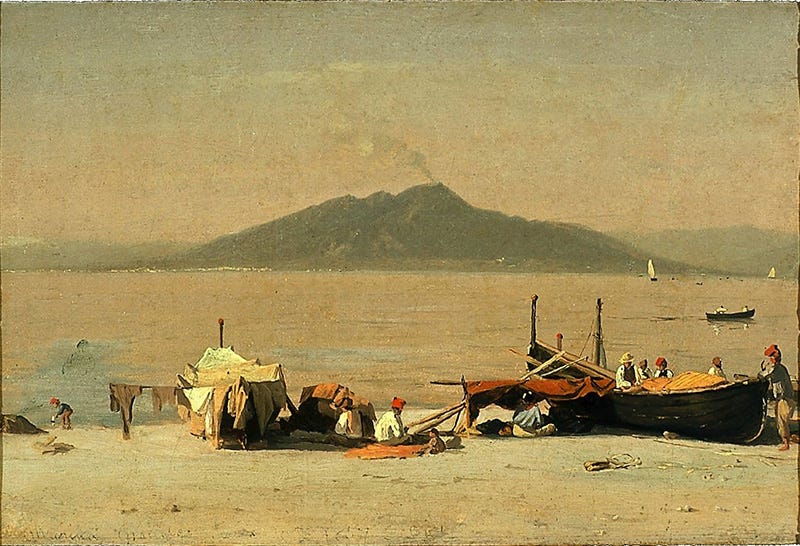
—Mount Vesuvius from Marina Grande, Capri, 1857. Sanford Robinson Gifford. (credit)

While we’ll never know exactly what Longfellow and Greene got up to in Naples, we can know more about his approach to traveling. In his book Outre-Mer, he did provide some comical—and surprisingly still relevant—comments about the types of tourists he encountered in Italy. This gives us a bit of insight into his views on traveling and experiencing new places.
Even though Longfellow wasn’t particularly enamored with Florence on his first visit in 1828, at that time the city was a crossroads of the Grand Tour. This gave him the chance to meet a number of different types of travelers:
I met with an odd character at Florence, — a complete humorist. He was an Englishman of some forty years of age, with a round, goodhumoured countenance, and a nose that wore the livery of good company. He was making the grand tour through France and Italy, and home again by the way of the Tyrol and the Rhine. He travelled post, with a double-barrelled gun, two pair of pistols, and a violin without a bow. He had been in Rome without seeing St. Peter's, — he did not care about it; he had seen St. Paul's in London. He had been in Naples without visiting Mount Vesuvius; and did not go to Pompeii, because "they told him it was hardly worth seeing — nothing but a parcel of dark streets and old walls." The principal object he seemed to have in view was to complete the grand tour.
I afterward met with his counterpart in a countryman of my own, who made it a point to see every thing which was mentioned in the guidebooks; and boasted how much he could accomplish in a day. He would despatch [sic] a city in an incredibly short space of time. A Roman aqueduct, a Gothic cathedral, two or three modern churches, and an ancient ruin or so were only a breakfast for him. Nothing came amiss; not a stone was left unturned. A city was like a Chinese picture to him — it had no perspective. Every object seemed of equal magnitude and importance. He saw them all; they were all wonderful.
Life is short, and art is long; yet spare me from thus travelling with the speed of thought; and trotting from daylight until dark, at the heels of a cicerone, with an umbrella in one hand, and a guidebook and plan of the city in the other.13
This is exactly the sort of gem that makes digging into older travel books such a joy. It had me trying to stifle a good and proper cackle on the train to Rome. Although nearly 100 years old, these types of tourists are surprisingly still relevant. While traveling around Italy today with a double-barrelled gun and two pairs of pistols might be challenging (and why a violin without a bow?), the traveler who only travels for the idea of traveling or of a place without actually seeing anything of the place or the traveler who breaks their back—and poor feet—trying to see everything are very recognizable figures. To one everything is a disappointment and to the other everything is indistinguishably wonderful.
While a good guide brings a place to life and a guidebook can give you a roadmap for your journey, Longfellow, it seems, is encouraging his readers to find something in between those two extreme types of travelers. Or, at least, per l’amore di dio, pack your violin bow.
Well, my friends, life is short, and this newsletter is long. Travel slow, and don’t forget to see the volcanoes along the way!
Know someone who loves the Amalfi Coast? Share Ciao Amalfi with them by clicking below. Grazie mille!
Longfellow, letter to Stephen Longfellow, 14 December 1827, in Longfellow, The Letters of Henry Wadsworth Longfellow, Volume I: 1814–1836: 247.
Longfellow, letter to Zilpah Longfellow, 26 March 1828, in Longfellow, The Letters of Henry Wadsworth Longfellow, Volume I: 1814–1836: 257.
The Letters: 257-8.
Noam Andrews, “Volcanic Rhythms: Sir William Hamilton's Love Affair with Vesuvius,” AA Files , 2010, No. 60 (2010): 12.
Cecilia Ciuccarelli e Dante Mariotti, “I terremoti nella STORIA: 28 luglio 1883, la catastrofe di Casamicciola sull’isola d’Ischia,” INGV Terremoti, 27 July 2018, https://ingvterremoti.com/2018/07/27/i-terremoti-nella-storia-28-luglio-1883-la-catastrofe-di-casamicciola-sullisola-dischia/.
Longfellow, letter to Stephen Longfellow, Jr., 22 April 1828, The Letters of Henry Wadsworth Longfellow, Volume I: 1814–1836: 259.
The Letters: 259-60.
The Letters: 260.
The Letters: 260.
Longfellow, letter to Longfellow Sisters, 1 September 1828, in Longfellow, The Letters of Henry Wadsworth Longfellow, Volume I: 1814–1836: 279.
Longfellow, Introduction, The Letters of Henry Wadsworth Longfellow, Volume I: 1814–1836: 9.
George Washington Greene, The Life of Nathanael Greene, Major-General in the Army of the Revolution (Houghton, Mifflin & Company, 1890), iii-v.
Longfellow, Outre-mer: A Pilgrimage Beyond the Sea, Volume 2 (Harper & Brothers, 1835), 144-45.
A beautifully written piece and I enjoyed reading about the friendship between Longfellow and Greene - fortunate are those who experience such deep, long-lasting friendships in their lives. Also, a touching portrayal of youth. This line from Greene teared me up, both for myself (not being quite so young anymore but remembering those days fondly - as you say, holding them close to our hearts), and for my daughter and her friends who are now around the young adult ages (late teens/early 20's) that these young men were back then: "We were young then, with life all before us."
I love the concept of volcano, tourism! And the wines that emerge from volcanic soil are splendid!